

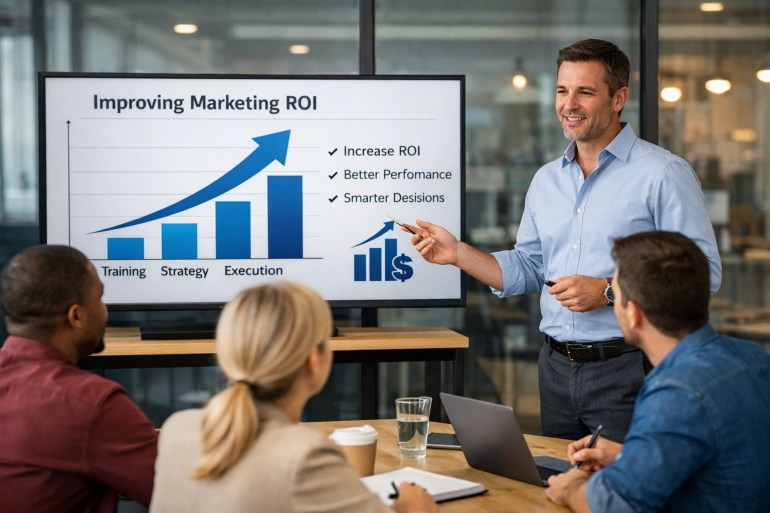
Improving Marketing ROI: How Education Drives Marketing Team Development
Most businesses devote significant resources to campaigns and technology with the expectation of tangible returns. However, many still find themselves struggling to improve marketing performance and justify investment. The reality is that maximizing marketing ROI is less a matter of budget and more often an outcome of knowledge, discipline and structured learning. Organizations that actively invest in marketing education for business and prioritize ongoing training can achieve compounding benefits far beyond what AD spend and software investments alone deliver.
Rethinking the Real Drivers of Marketing ROI Improvement
Many companies tend to believe that increasing marketing budgets or acquiring new tools will instantly improve marketing performance. While larger budgets may open new avenues, they rarely resolve fundamental issues that restrict growth. More often than not, ROI challenges stem from knowledge gaps within the internal team. Marketers who lack skills in analytics, content strategy or AI-driven tools miss out on key opportunities. Poor insights can lead to ineffective targeting, misaligned messaging and inefficient budget allocations. Addressing these gaps through targeted marketing team development frequently yields better outcomes than increasing spend alone.
The Compounding Value of Marketing Training Investment
Investing in the ongoing growth of internal marketing teams enables organizations to unlock compounding benefits. Education equips staff with the latest tactics for effective channel management, optimization and reporting. When organizations embrace consistent marketing training investment, employees cultivate skillsets that stack year over year, positively impacting every subsequent campaign. Even a single course in analytics or the use of Robotic Marketer SaaS can drive immediate performance improvements while laying a foundation for long-term gains. Small, regular investments in upskilling can dramatically increase efficiency and creativity, resulting in measurable advances in marketing ROI improvement.
Identifying the Best Marketing Education for Business Growth
Several areas of training consistently deliver outsized returns for marketing teams. First, analytics training ensures staff can interpret data, measure success effectively and make informed decisions that improve marketing performance. Understanding what data to track, and how to act on those insights, is central to impactful campaigns. Second, education around content strategy sharpens the ability to communicate compelling messages, create engaging formats and refine narratives that speak directly to audiences. Third, paid media optimization teaches marketers to run efficient advertising campaigns that maximize each dollar spent. Finally, hands-on experience with AI tools helps teams leverage advanced platforms like Robotic Marketer SaaS to automate tasks, refine targeting and forecast trends more accurately.
Marketing Team Development: Structuring Training for Consistency and Impact
Structured professional development is essential for sustainable marketing ROI improvement. Yet, the main obstacle is often the fear that upskilling pulls team members off high-priority projects. Leading organizations address this by integrating learning opportunities into daily operations. Microlearning modules, on-demand video sessions and regular internal workshops minimize disruption. When supported by an Outsourced Marketing Department or external coaches, these routines keep teams nimble without stalling execution. Frameworks that encourage ongoing knowledge sharing—such as monthly analytics reviews or live content planning sessions—embed learning into the operating rhythm.
Balancing Execution with Ongoing Marketing Training Investment
Continuous education does not have to compete with production timelines. Modern learning strategies emphasize flexibility. For instance, website development teams can participate in quick workshops between sprints, updating their skills in the latest SEO or usability standards. Content creators can schedule short lessons on emerging storytelling trends or AI-based editing technology, often using platforms similar to Marketing Eye Magazine for peer feedback. With thoughtful scheduling and built-in feedback sessions, ongoing development complements delivery milestones without jeopardizing project outcomes.
Missed Opportunities and Hidden Costs When Teams Lack Training
A failure to invest in marketing education for business can lead to visible and hidden losses. Teams operating with outdated playbooks waste effort on low-performing tactics and miss high-impact channels. Analytics blind spots mean that teams may continue spending on campaigns that underperform or ignore positive trends that could scale. This leads to wasted AD spend, missed conversion opportunities and slower brand growth. In the absence of robust marketing team development, talented professionals may leave for organizations that support their ambitions, further compounding the cost of retraining or hiring. A stagnant learning culture can ultimately set back an organization for years, eroding hard-won reputation and market share.
Choosing the Right Training Areas for High Marketing ROI Improvement
Selecting the most effective areas for upskilling depends on the current skills matrix and strategic priorities of the organization. For analytics, companies should emphasize tools that align to both their tech stack and industry benchmarks. Content strategy should focus not just on creativity but also on channel-specific best practices—social, email or video. Paid media specialists benefit from advanced platform certifications and real-world campaign management exercises. The highest yields may come from AI-driven program training with solutions such as Robotic Marketer SaaS, giving teams a blueprint for scalable success in marketing strategy development and execution.
Avoiding Talent Attrition through Marketing Team Development
Talent development programs have become an essential differentiator in attracting and retaining top marketing talent. Professionals value employers who invest in their personal growth and ensure ongoing relevance in a fast-changing field. When managers provide regular access to skill-building sessions, career development pathways become clear and measurable. Internal mobility, mentorship programs and certifications signal a commitment to employees. This reduces attrition, encourages loyalty and builds a vibrant learning culture that benefits overall business outcomes. By prioritizing marketing training investment, organizations not only improve marketing performance but also strengthen team cohesion and motivation.
Integrating Media and Community Learning into the Training Strategy
Modern marketers access information and wisdom from curated media sources as often as from formal training. Subscriptions to sector-leading publications such as Marketing Eye Magazine expose teams to innovative ideas, industry benchmarks, and interviews with thought leaders from across the globe. Building reading groups or internal discussion forums around these resources stimulates debate and inquiry, reinforcing formal education with current, real-life examples. A marketing team that reads—and reflects together—builds a collective intelligence which cascades to campaign outcomes and decision making. Incorporating industry media and magazine-based idea sharing programs ensures that teams remain informed on best practices, regulatory shifts, and global market trends.
Technology-Driven Training: Embracing Tools such as Robotic Marketer SaaSArtificial Intelligence, once a distant aspiration, now stands at the center of strategic marketing training investment. Teams that learn how to use purpose-built tools such as Robotic Marketer SaaS stand out in terms of speed and sophistication. These platforms accelerate research, automate competitor analysis, and personalize campaign strategies based on extensive data. Training in AI-powered applications stresses practical adoption, helping teams move from experiments to standardized processes. As a result, organizations see faster, more sustainable improvements in marketing ROI. The key lies in making such training hands-on, tailored to real-world processes, and accessible across seniority levels.
Case Study: Website Development Teams and the ROI of Ongoing Upskilling
Website development functions as a clear example of the payoff from regular learning. Teams that engage in frequent training on usability, user experience, and SEO enhancements reliably outperform stagnant groups. Courses focused on analytics integration and measurement foster improved conversion tracking. Insights from Marketing Eye Magazine and AI advisory can inspire fresh perspectives on visual layout and engagement mechanics. Well-trained development staff can swiftly diagnose site bottlenecks and recommend enhancements that have direct, measurable impacts on sales pipelines and digital brand perception. Regularly scheduled knowledge reviews not only motivate technical teams but directly advance revenue goals.
How Outsourced Marketing Departments Plug Internal Knowledge Gaps
Many organizations supplement their workforce with an Outsourced Marketing Department, benefiting from deep sector insight and an external perspective. These services rapidly scale access to expertise, reduce ramp-up times for new campaigns, and provide ready-made training for internal teams. Expert-led workshops, knowledge transfer sessions, and on-the-job shadowing help in-house marketers absorb new skills from experienced professionals. Outsourced specialists can also drive implementation of platforms like Robotic Marketer SaaS, providing hands-on demonstrations and templates that embed learning into daily practice. In this way, outsourced departments become both accelerators of marketing ROI improvement and educators of the internal workforce.
Embedding Training in Annual Planning and Performance Reviews
For maximum impact, organizations should incorporate marketing education for business as a central pillar of annual planning. Setting measurable training objectives and aligning them with broader business metrics clarifies value added by personal development. Regular performance reviews should highlight new certifications, knowledge applied to recent projects, or mentorship roles undertaken. A culture of recognition for innovation and new learning encourages team members to seek out additional development opportunities. Such structures not only tangibly improve marketing performance, but also sustain a positive feedback loop for organizational growth and adaptability.
Next Steps: Building a Sustainable Learning Culture
Dedicating time and budget to ongoing marketing training investment yields more than immediate ROI gains. It cultivates resilience and adaptability within teams, transforms skillsets with every cycle, and supports future-facing strategies. By leveraging tools such as Robotic Marketer SaaS, engaging with Outsourced Marketing Departments, learning from sector media including Marketing Eye Magazine, and prioritizing website development upskilling, businesses pave the way for lasting improvements in marketing team development. A learning-centered culture ensures that as markets and technology shift, teams stay prepared, proactive, and capable of reaching new heights in marketing ROI improvement for years to come.


Leave a comment
Make sure you enter all the required information, indicated by an asterisk (*). HTML code is not allowed.