

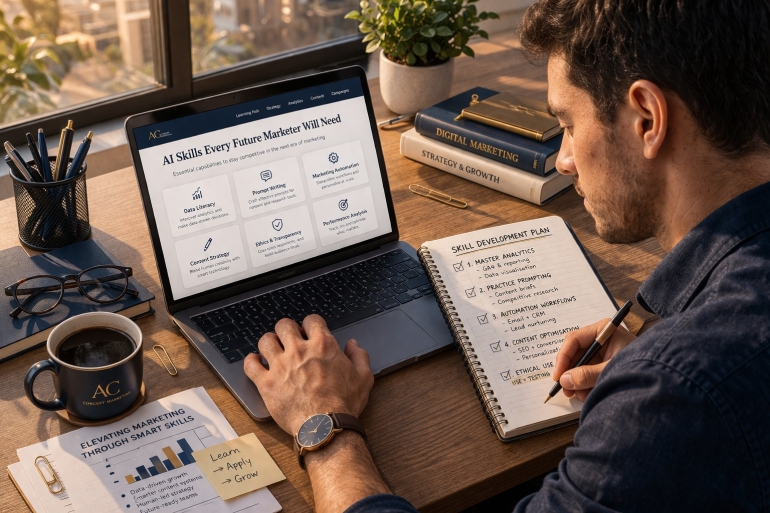
AI Skills for Marketers: Essential Tools for Future Marketing Careers
Artificial intelligence has dramatically transformed marketing across every sector. Brands now expect teams to have foundational expertise in AI and marketing technology skills. As automation and analytics tools become more accessible, understanding how to use and strategize with these platforms is essential. Future marketing skills require individuals to be adaptable, proactive and committed to ongoing learning, making AI literacy for marketers a necessity. Businesses that recognize this shift are prioritizing the development of internal AI capability, ensuring greater efficiency, efficacy and strategic direction in all marketing functions.
Why AI Literacy for Marketers Matters
AI literacy for marketers means more than a basic understanding of artificial intelligence principles. It involves grasping how these systems impact workflows, communication and measurement. With AI-driven campaigns delivering more precise insights and automating repetitive tasks, teams are free to concentrate on strategic work. This baseline expectation has changed hiring; companies now prioritize candidates with exposure to AI marketing tools. Those who understand AI can interpret data faster, map buyer journeys with greater precision and optimize content on the fly. In 2026, familiarity with AI is as fundamental to marketing as understanding social media or email campaigns was a decade ago.
Core AI Skills for Marketers to Build for the Future
Future marketing skills are more technical than ever before, but not inaccessible. AI marketing careers now demand proficiency in specific capabilities such as prompt engineering, data interpretation and workflow automation. Each of these core skills empowers professionals to use tools more effectively, draw actionable insights from analytics and manage campaigns with greater autonomy. As a result, marketing teams can scale their efforts without additional headcount, improving return on investment while maintaining creative control. These marketing technology skills have become essential for anyone entering or currently working in marketing.
Prompt Engineering: Communicating with AI
Prompt engineering refers to developing skillful commands and inputs for AI systems. Marketers now regularly use AI chatbots, content generators and analytics platforms that depend on precise prompts for optimal results. Those who can design effective prompts will get better output—be it copy variations, campaign suggestions or data summaries. This bridges the gap between technical systems and real-world marketing needs. Even without computer science experience, marketers can learn prompt engineering through simple experimentation, online tutorials and by observing examples from industry thought leaders. It is quickly growing into one of the key AI skills for marketers.
Data Interpretation: Turning Information into Insights
Another central pillar of future marketing skills is data interpretation. AI platforms handle massive datasets, but their findings are only actionable when interpreted correctly by humans. Marketers must know how to read dashboards, spot trends and ask the right questions about anomalies. This knowledge helps in refining ongoing campaigns, testing theories and making recommendations that align with business goals. Many platforms, like Robotic Marketer SaaS, simplify analytic processes, turning data into user-friendly reports. Marketers who practice active data interpretation can steer decision-making and enhance campaign performance.
Workflow Automation: Streamlining Marketing Operations
AI excels at automating repetitive or manual Marketing tasks. The skill lies in understanding what should be automated and how to establish those flows. Workflow automation can cover everything from sending personalized emails to updating AD budgets or reporting on campaign status. Marketers who can map out processes for an Outsourced Marketing Department or internal team will find these automations lead to fewer errors and greater consistency. Mastering this AI skill saves time for strategic activities, maximizes existing resources and strengthens measurement practices.
How AI Transforms Everyday Marketing Roles
AI has altered every aspect of the marketer’s role, affecting strategy, content creation, analytics and media buying. Strategy development now integrates AI-powered trend analysis and persona modeling. With tools like Robotic Marketer SaaS, marketers create roadmaps and scenarios based on predictive data rather than just intuition. Content generation leans on AI’s natural language capabilities to deliver fresh variations, tailored headlines and even full articles. For platforms like Marketing Eye Magazine, this means more timely production cycles and deeper audience targeting. As media buying platforms integrate AI, professionals can optimize placements in real time based on live performance metrics.
Strategy Alignment with AI Insights
Strategic planning in marketing benefits extensively from AI’s predictive power. Platforms can suggest content topics, identify market opportunities and flag underperforming channels. Marketers now use these AI suggestions to inform website development or campaign design for an Outsourced Marketing Department. This evidence-based approach supports higher accuracy in forecasting and more reliable resource allocation. The skill required is not just running the AI tool, but understanding how these insights fit the broader brand narrative and business objectives.
Content Creation and Personalization Enhanced by AI
AI-driven content solutions support marketers in generating creative assets quickly and at scale. Whether producing feature pieces for a brand’s magazine or creating copy for digital ads, AI suggestions often increase productivity and improve engagement rates. The real advantage appears when marketers know how to pair this technology with deep audience understanding, ensuring each asset supports conversion goals. Personalization features allow for adaptive content delivery, responding to user preferences in real time. Practicing these future marketing skills leads to higher satisfaction rates among diverse audience segments.
Analytics, Measurement and ROI Assessment Using AI
Real-time performance measurement is one of the most significant shifts AI brings to marketing analytics. Teams can track KPIs minute by minute, adjusting tactics to maximize results. This capability extends to website development, where engagement metrics pinpoint friction points and conversion opportunities. As AI becomes central to reporting, marketers with marketing technology skills are better prepared to dissect data and communicate success. Interpreting dashboards, setting benchmarks and conducting split testing are core tasks that benefit from a higher degree of AI literacy for marketers.
Streamlined Media Buying and Optimization
AI now powers most prominent AD platforms, allowing media buyers to set performance thresholds, audience segments and creative combinations that update automatically. A marketing professional who understands how AI underpins these automations can maximize spend, minimize waste and spot performance trends ahead of competitors. Developing this particular AI skill for marketers means learning both the technical and creative aspects of platform management. The result is greater campaign agility and a stronger bottom line.
Knowing the Difference: Using AI Tools vs. Understanding AI Strategy
Simply operating AI tools does not guarantee marketing success. Many professionals can follow tutorials or use templates, but the future belongs to those who understand the underlying AI strategy. Operators react to changes; strategists anticipate them. Knowing when to deploy a tool, why to trust a recommendation or how to tailor workflows for specific outcomes makes the difference. As an example, using Robotic Marketer SaaS can automate large portions of campaign planning, but only those with deeper insight will harness its full value. Training in how AI informs holistic business objectives is what separates proficient from exceptional marketers.
Long-Term Perspective in AI Marketing CareersDeveloping marketing technology skills for strategy means keeping up with best practices in data privacy, machine learning ethics and cross-channel orchestration. Marketers who think beyond the immediate campaign recognize that AI can influence lifetime customer value, not just acquisition costs. This nuanced perspective helps bridge technical solutions with human-centered messaging. As more organizations seek in-house expertise, roles in an Outsourced Marketing Department may pivot from basic operation to AI strategy leadership, guiding broader investments and adoption.
How to Start Developing AI Skills for Marketers Without a Tech Background
The best time to start building AI skills for marketers is now, regardless of existing technical ability. Many online resources, webinars and certification programs offer gentle introductions to AI methods and their marketing applications. For those focused on content, interactive learning modules teach prompt engineering step by step. Experimenting with available tools, from workflow automators to content generators, allows professionals to quickly develop practical fluency. Companies investing in Outsourced Marketing Departments often provide access to advanced systems like Robotic Marketer SaaS for ongoing learning.
Continuous Learning and Professional Development Opportunities
Continuous professional development is key to staying competitive in 2026. Marketers should subscribe to newsletters or join forums centered on AI marketing careers. Reading whitepapers, attending conferences or collaborating on real-life projects gives direct exposure to evolving best practices. Teams working closely with AI platforms in website development or publishing for a magazine gain firsthand experience managing automation, data and personalization. When individuals commit to lifelong learning, they position themselves at the forefront of industry change, ready to add value immediately.
Peer Learning and Collaboration for Future Marketing Skills
Learning from peers accelerates the acquisition of new abilities. Forming study groups or chat forums centered on marketing technology skills supports collective growth. Marketing Eye Magazine, for example, features industry leaders sharing practical use cases. Reading about others’ successes and failures helps demystify technical topics. This environment encourages experimentation, risk-taking and rapid upskilling, which all drive relevancy in the market. Inviting team members to teach internal workshops or share toolkits fosters a culture of innovation and continuous improvement.
Practical Application: AI in Website Development
Applying AI skills for marketers does not demand advanced math or programming knowledge. In website development, for instance, AI plugins help analyze user behavior, personalize landing pages and optimize speed. Professionals work with developers to deploy these solutions, learning through hands-on collaboration. Reviewing feedback from users informs next steps and helps cement technical concepts. The ultimate aim is to make digital environments more helpful for customers, increasing engagement and conversion rates. Each application builds both skill set and confidence.
Current and Future AI Tools Every Marketer Should Explore
AI tools do not remain static. New releases and updates occur monthly, introducing advanced capabilities and new learning opportunities. Leading marketing professionals allocate time each week to explore emerging platforms—whether AI-driven design tools, semantic analysis engines or campaign automation plugins. The Outsourced Marketing Department model makes exploring these platforms more accessible, pooling knowledge and experience from a variety of campaigns. Ensuring familiarity with Robotic Marketer SaaS or similar platforms remains important, as these continue to shape strategic planning, reporting and team coordination across regions and industries.
Staying Adaptable in Changing Environments
Adaptability will remain the single best predictor of career longevity for marketers. Technology does not remain static; as requirements shift, professionals must adjust. Future marketing skills call for a balance of technical knowledge, communication ability and creative judgment. AI literacy for marketers ensures they can communicate with IT teams, translate complex findings and apply solutions creatively. Flexibility enables individuals and organizations to re-imagine products or services as AI capabilities grow stronger, always maintaining focus on customer outcomes.
The Value of Cross-Functional Skill Sets
Future-ready marketers recognize the need for hybrid expertise that covers technology, communication and strategy. By knowing how to deploy marketing technology skills alongside storytelling and analysis, they fill the gaps between departments. Professionals who understand both the how and the why of AI applications are better suited for leadership roles in completed and emerging markets. This cross-functional perspective also prepares them to recruit, train and lead teams that will shape the next era of marketing success.


Leave a comment
Make sure you enter all the required information, indicated by an asterisk (*). HTML code is not allowed.