

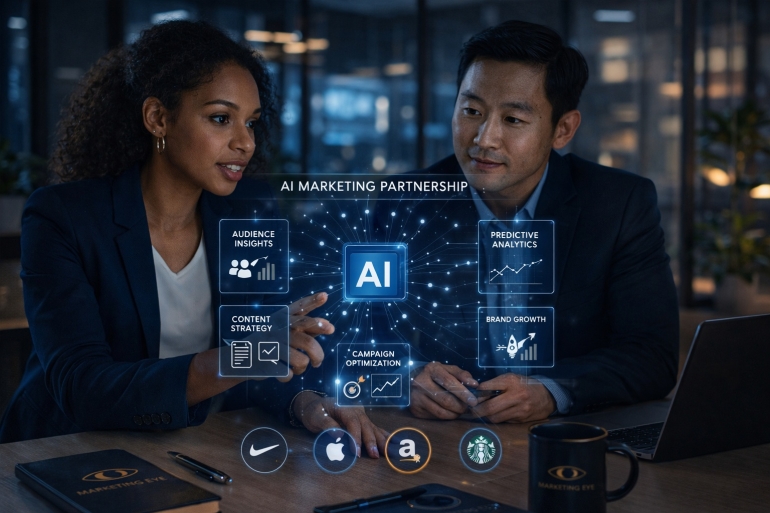
The Role of AI in Marketing Partnerships: Building Stronger Collaborations Through Technology
Artificial intelligence (AI) is redefining how companies and agencies work together, transforming once-static partnerships into agile collaborations. Businesses seek ways to achieve greater returns on investment, achieve clarity in complex digital channels and make the most of limited resources. AI does not simply automate processes, it acts as a bridge that connects data, people and platforms across the marketing ecosystem. With the right approach, technology can foster genuine alignment, accelerate decision-making and deliver measurable outcomes for both brands and agencies.
AI in Marketing: From Innovation to Everyday Reality
The use of AI in marketing started as an experiment but quickly progressed to everyday necessity. Marketers across all industries recognize its capacity to analyze large volumes of data, identify patterns and pinpoint what truly drives customer behavior. AI in marketing now includes elements such as predictive analytics, natural language processing and machine-driven creative optimization. As a result, modern marketing collaborations look and operate much differently than those of the past ten years. Both agencies and businesses embrace platforms that promise more efficient reporting, insightful analysis and actionable strategy development.
Transforming Traditional Client-Agency Relationships
Traditionally, client-agency relationships operated on monthly meetings, delayed feedback and manual reporting cycles. AI tools for agencies have dramatically shortened those cycles. Marketers can now create real-time dashboards, automate campaign reporting and rapidly identify opportunities or challenges as they arise. This leads to closer, more transparent relationships between businesses and their marketing partners. Stakeholders can align their objectives and fine-tune campaigns more nimbly, ensuring shared success and ongoing optimization.
AI Tools for Agencies Empower Teams
The emergence of AI tools for agencies has redefined what marketing partnerships look like. Rather than siloed workstreams, these tools enable more connected workflows where all parties access the same data, insights and recommendations. This has empowered agencies to provide higher value, support clients’ goals and adapt quickly to shifting market forces.
AI-Powered Marketing Strategy Platforms AI-powered marketing strategy platforms have gained popularity among teams seeking smarter ways to collaborate. For example, Robotic Marketer SaaS leverages AI algorithms to generate strategic blueprints using data and industry benchmarks. Such platforms help agencies and brands map out entire campaigns, forecast potential outcomes and align creative decisions to business goals. Automated processes facilitate more regular check-ins between partners, ensuring that everyone moves forward with a shared vision and concrete action plans.Improved Content Collaboration and Asset Management
Another key advantage of AI in marketing partnerships lies in content management. Teams can use AI-driven systems to store, organize and tag assets, making it easy to track campaign components and maintain brand consistency. With centralized content repositories and automated approval flows, external partners and in-house teams stay aligned, reduce errors and streamline production timelines. This helps ensure that campaigns reach their audiences quicker, with messaging that resonates strongly.
How Marketing Collaboration Technology Builds Value
Effective marketing collaboration technology can eliminate bottlenecks and foster closer working relationships. Communication often stands as a central challenge in agency-brand partnerships. AI tools can bridge this gap, ensuring that insights flow freely and stakeholders understand progress at every stage.
Real-Time Reporting and Actionable InsightsAI tools for agencies enable real-time performance monitoring which transforms how decisions get made. Instead of waiting for month-end analysis, teams can see campaign impacts as they happen. Automated dashboards flag unusual trends or performance dips, prompting timely interventions and giving both agencies and businesses the chance to respond with agility. These insights drive smarter creative choices and reallocation of resources, optimizing results with each iteration.
Personalized Engagement Without Losing Perspective
One popular misconception is that AI-powered marketing strategy means less human creativity or less concern for unique brand voices. In practice, marketing collaboration technology empowers partners to deliver personalized campaigns built around audience insights while still giving strategists and creatives the freedom to fine-tune messages. AI supports decision-making, but the final vision always benefits from human intuition, experience and local market understanding.
AI Marketing Partnerships: Aligning Strategy, Voice and Brand
AI marketing partnerships flourish when technology amplifies human strengths instead of replacing them. Successful collaborations strike a balance between automation and strategy. Outsourced marketing departments, for example, can use AI tools to streamline workflow—but clients still depend on experienced professionals to steer brand storytelling, negotiate challenges and identify fresh opportunities. Genuine success comes from integrating people, platforms and proven methodologies in a coherent, proactive way.
Maintaining Authenticity in Automated Processes
Automating routine tasks frees up time for strategic thinking and creativity. When used carefully, AI can support brand voice by ensuring consistent language and messaging. However, it is vital to avoid over-automation. Agencies and businesses who rely strictly on technology risk sounding generic or losing touch with core values. Teams need to monitor outputs and continue investing in creative collaboration—finding the right balance preserves authenticity and builds stronger partnerships.
Outsourced Marketing Departments and the Human Factor
Many companies consider outsourced marketing departments that utilize AI-driven processes to optimize campaign execution. These partnerships remain successful when agencies retain strategic flexibility and leave room for dialog. Technology can assist with media buying, content personalization and market analysis, yet marketing leaders should continue to provide insights that drive business growth. Human judgment and experience remain irreplaceable for high-stakes decisions or creative pivots.
Evaluating AI Claims: How to Assess True Technology Integration
With AI in marketing enjoying increased attention, many agencies claim to use the latest automation platforms. Yet, businesses need to distinguish between real value and surface-level adoption. Technology promises results only when it powers genuine collaboration and data-driven outcomes.
Investigating Tools, Processes and Results
Start by asking direct questions about which AI tools for agencies support campaign planning, content production and performance tracking. Assess how partners use technology to boost efficiency, generate insights or improve reporting accuracy. Request samples of AI-generated reports, dashboards or recommendations, and challenge partners to show how automation enhances both strategic planning and execution. True technology adoption involves transparent discussion around platforms, processes and measurable results.
Benchmarking Agency Performance Through Data
AI-powered marketing strategy platforms create data-rich environments where performance metrics are readily available. Brands can compare results across campaigns, channels and audiences to validate agency contributions. By demanding clear benchmarks and regular analytical updates, businesses ensure that technology pays off through accountability and consistent improvement.Risks of Over-Automation: Safeguarding the Brand Voice
As AI marketing partnerships rely more on automation, potential downsides begin to surface. Over-reliance on templates, algorithms or pre-set creatives can flatten messaging or reduce differentiation. The risk multiplies when agencies and brands shift too many processes onto automated channels without regular review or human oversight.
Maintaining Balance With Regular Oversight
To guard against losing a brand’s unique presence, agency and client teams should implement consistent review processes. Ensure that both strategic and creative decisions receive input from experienced marketing professionals. Review AI-generated content, evaluate campaign messaging and cross-check outputs with brand guidelines. Regular feedback sessions encourage improvement while protecting tone, style and vision.
Marketing Eye Magazine: Extending Brand Voice With Editorial Control
Beyond campaign execution, partnerships can leverage branded platforms such as Marketing Eye Magazine. Magazines and editorial properties amplify thought leadership, create new audiences and provide unmatched visibility. While AI can support content planning and distribute articles across digital channels, it is vital for editorial teams to direct the narrative and oversee quality. Keeping control over long-form and thought leadership content ensures that the brand’s story continues to evolve with integrity, consistency and relevance.
Website Development: Synergy Between AI and Human Creativity
AI-driven tools have streamlined many aspects of website development. Automated site audits, content suggestions and customer journey analysis support teams as they design user-centered digital experiences. For agencies and their partners, AI reduces manual tasks such as keyword research or page-speed diagnostics, helping projects move quickly from brief to execution.Where Technology Supports, People Innovate
AI in marketing excels when paired with hands-on web designers, developers and strategists. Technology can suggest layouts or optimize site structures, but creative professionals ensure that digital properties reflect the brand’s character and inspire trust. Collaborators should use AI as a toolkit for efficiency and focus energy on user experience, storytelling and conversion strategies. Pooled expertise creates websites that perform on every level—from SEO to design and engagement.
Continuous Improvement Through Data and Feedback
Post-launch, AI-powered marketing platforms continuously monitor site performance. Dashboards track visitor behavior, identify navigation challenges and flag opportunities for conversion rate optimization. With fast access to actionable insights, marketing teams and external partners can iterate site updates regularly, maintaining high levels of performance and visitor engagement over time.Enabling Growth: Beyond Automation to Partnership Excellence
Strong marketing partnerships go well beyond simply sharing dashboards or reports. Agencies must commit to ongoing collaboration, knowledge-sharing and strategic counsel. When AI-powered marketing strategy platforms supplement these processes, brands benefit from performance gains, stronger alignment and ever-greater creativity.
Continuous Learning and Upskilling
Both agency and client teams need to commit to continuous learning, adapting to new AI tools and changing industry norms. Regular training, workshops and open discussions foster an environment where everyone can benefit from recent advances in marketing collaboration technology. Building collective capability ensures that partnerships achieve lasting business growth and outpace competitors.
Transparency and Shared Success Metrics
No matter how advanced the AI systems, transparency remains indispensable in marketing partnerships. Clear, agreed-upon metrics support honest evaluation and build trust between partners. AI tools for agencies support this transparency with regular updates, KPI dashboards and automated reporting. Setting shared goals from the outset—and adapting them as campaigns progress—helps teams meet targets and celebrate successes together.
Future Potential: New Frontiers in AI-Driven Collaboration
As technology evolves, prospects for AI in marketing partnerships continue to expand. Future AI tools may offer even more granular audience insights, proactive optimization and cross-channel orchestration. Already, platforms like Robotic Marketer SaaS are setting standards in automated strategy formulation and data-driven planning. Increasingly, marketing teams will rely on AI to anticipate trends, streamline processes and minimize wasted effort at every stage of engagement.
Human Ingenuity Remains Essential
Technology never replaces the need for creativity, intuition or industry expertise. AI in marketing partnerships provides the framework, but agencies and brands must still push boundaries, take risks and experiment with fresh formats. Combining smart automation with human ingenuity maintains the brand’s edge and helps capture the interest of diverse audiences in all markets.


Leave a comment
Make sure you enter all the required information, indicated by an asterisk (*). HTML code is not allowed.